Most parents know that magical moment when your kids blast through the back door smelling of sunscreen, dirt and whatever that unmistakable funk of summer fun is.
And then you spot it.
A tick.
Cue the internal parent spiral: Is it dangerous? How long has it been there? Do we need to go to urgent care? Why are ticks so tiny and yet so dramatic?
Fortunately, most tick bites are more annoying than serious. But because ticks can sometimes spread illnesses, it’s important to know what to watch for, when to stay calm and when to get medical help.
Skip the doomscrolling. We’ve got you.
What does a tick bite look like?
Tick bites can be surprisingly easy to miss. They’re small, painless and easy to miss, often in hidden in spots like:
- Behind the ears
- Along the hairline
- Under the arms
- Around the waistband
- Behind the knees
- Between toes
A tick bite may look like:
- A tiny red bump
- A small scab
- Mild swelling around the bite
- A tiny dark brown or black speck attached to the skin
Filed under “gross but useful,” that last point usually means the tick is still attached. After feeding, it may appear larger or swollen.
How serious is a tick bite?
Most tick bites do not lead to serious illness. But some ticks can carry germs – including bacteria and, more rarely, viruses – that can spread through their bite.
Ticks may carry bacterial diseases, including:
- Lyme disease: The most commonly known tick-borne illness is spread by blacklegged ticks (sometimes called deer ticks). Known for a rash that may expand in a circular pattern over time.
- Rocky Mountain spotted fever: More common in the southeastern and south-central U.S. This illness can progress quickly and may require prompt treatment.
- Anaplasmosis: Often seen in the Northeast and Upper Midwest
- Ehrlichiosis: Occurring most often in the South and South-Central U.S.
The risk of getting sick from a tick bite depends on:
- The type of tick
- Where the bite happened
- How long the tick was attached
In general, a tick usually needs to stay attached for several hours before the risk of disease transmission increases. That’s why finding and removing ticks quickly matters.
What are the symptoms of tick-borne illness?
Tick-borne illnesses don’t usually appear right away. And early symptoms often look like something much more common – like a regular virus.
Watch for signs such as:
- Fever
- Fatigue or low energy that doesn’t fit your child’s usual pattern
- Headache
- Muscle or joint pain
- Rash
- Flu-like symptoms that don’t seem to improve
The key is timing: symptoms may appear days to weeks after a bite.
Bulls-eye or no? The so-called “bull’s-eye” rash linked to Lyme disease doesn’t show up with every case. But if you notice a spreading circular rash – especially one that keeps growing – it’s time to get medical care.
How can I prevent tick bites?
Ticks love grassy, wooded and brushy areas – basically all the places kids love to explore in the great outdoors.
You can’t keep them confined to a bug-free zone, but a few simple habits can help lower the risk or tick bites:
- Dress to protect: Dress your child in long pants and long sleeves to create a barrier, and tuck pants into socks for extra protection. Ticks are easier to spot on light-colored clothing.
- Make repellent part of the plan: Use an EPA-registered insect repellent on exposed skin and clothing. Be sure to follow label directions for children.
- Wrap up the day with a rinse: If possible, have your child shower soon after coming inside to help wash off unattached ticks and make them easier to find.
- Do a timely tick check. Aim to do a full-body tick check for ticks within two hours of coming indoors.
What should I do if my child has a tick bite?
First: don’t panic.
Next: resist the urge to attack the tick with nail polish, a hot match, petroleum jelly, essential oils or other debunked removal myths.
The safest approach is actually pretty simple:
- Use fine-tipped tweezers to grab the tick as close to the skin as possible
- Pull upward steadily without twisting
- Clean the area thoroughly with soap and warm water
- Wash your hands
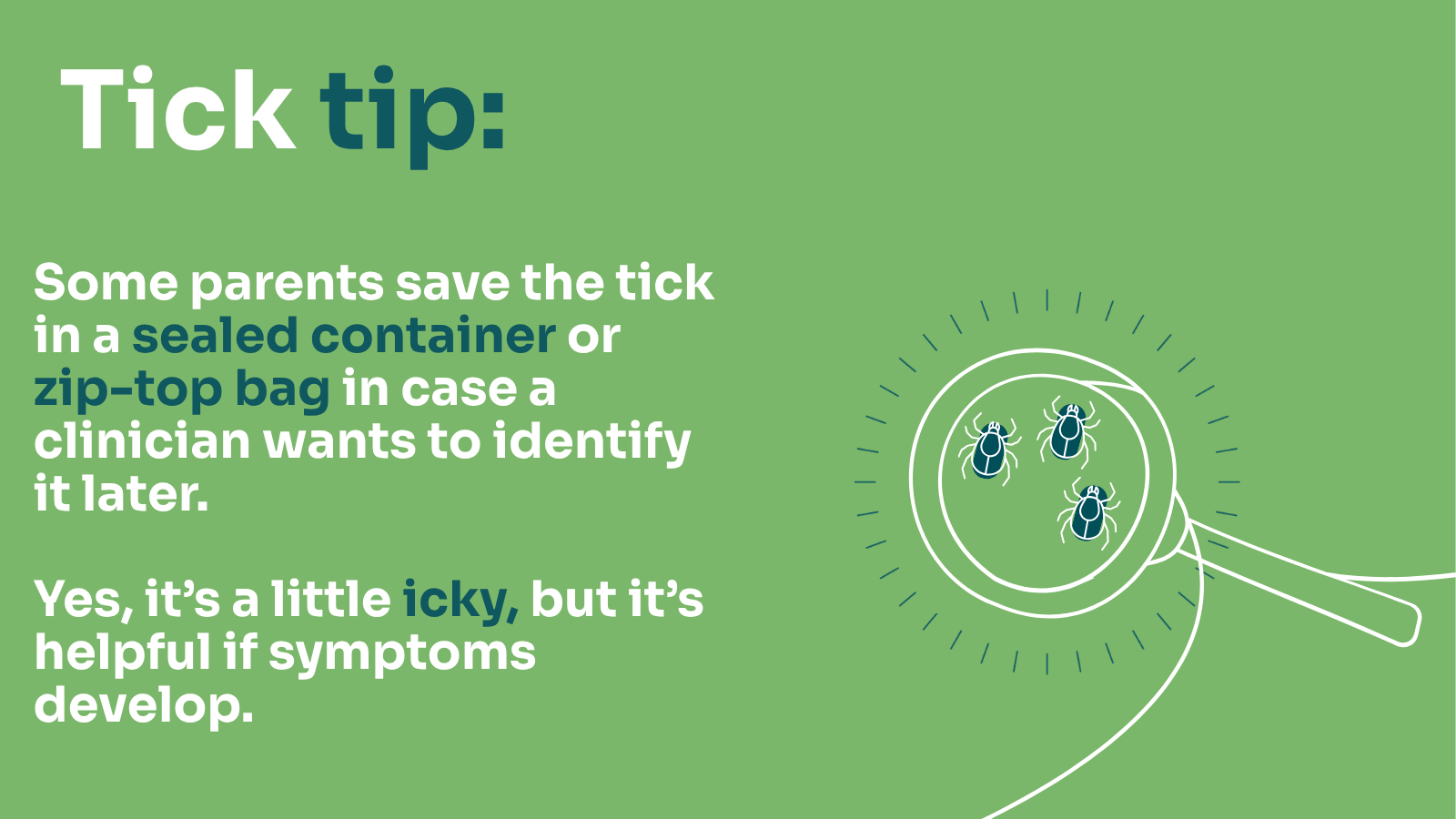
Don’t squeeze, crush or obliterate the tick while removing it. When a tick is stressed or injured, it may release bodily fluids that carry disease-causing germs or regurgitate stomach contents back into the skin. It can also make it harder to remove the head cleanly, leaving mouthparts embedded in the skin. (Just…ew.) If small parts of the tick remain, don’t try to dig them out. In most cases, the skin will naturally push them out over time – just like a splinter.
When should I get medical care for a tick bite?
A tick bite doesn’t always require medical treatment and can typically be handled at home. But there are times when it’s worth seeking care.
Urgent care is a great option if:
- You can’t fully remove the tick
- The bite area becomes increasingly red, swollen or painful (signs of infection)
- Your child develops fever, fatigue or flu-like symptoms
- A rash appears, especially a bull’s-eye pattern
- Your child complains of headache, muscle aches or joint pain
- The tick may have been attached for a long time
- You’re unsure whether the bite needs treatment
The good news is that most children who are treated early recover well.
Trust your “something feels off” instinct: Sometimes the earliest clue isn’t a specific symptom. It’s a child who just isn’t feeling quite themselves.
What does Indigo Urgent Care do for a tick bite?
At Indigo Urgent Care, we look at the whole picture – not just the bite.
A visit with one of our clinicians may include:
- Careful removal of any remaining tick parts, if needed
- A close look at the bite site for signs of irritation or infection
- Guidance on what symptoms to watch for and when they might show up
- A discussion of whether testing or antibiotics are needed, based on timing and risk factors
- Clear next steps so you’re not guessing after you leave
And because we know the importance of peace of mind, Indigo is focused on quick, convenient care that’s centered around you. Simply walk into one of our 45+ clinics, book a same-day or next-day appointment online, or connect face-to-face with an Indigo Virtual Care clinician. Live video visits are available in Washington state and Idaho.
In person or virtually, we’re here 8 a.m. to 8 p.m. every day – for tick season and all of life’s minor medical mishaps.